

Automate your print-on-demand business with the Shirtigo API
Automate fulfillment, printing and shipping with just a few API calls. Develop individual solutions, integrate your own stores or platforms and benefit from our scalable infrastructure - made in Germany.
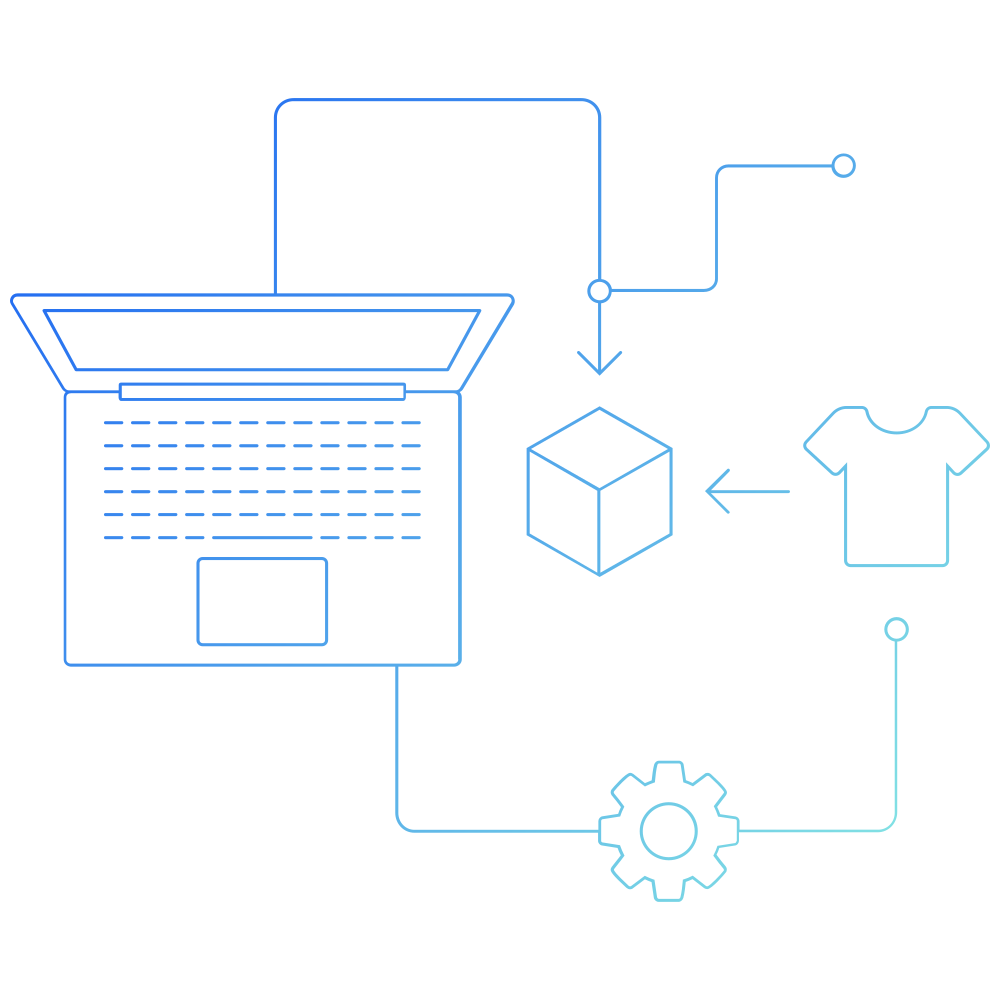
Customized print-on-demand workflows without limits

Easy to integrate
Easily integrate the print fulfillment API into existing systems - whether in-house development, newsletter or store system.

Flexible application options
Develop your own apps or product configurators and use the textile printing API for individual products and innovative web applications.

Scalable infrastructure
Extend (mobile) apps with merchandising and sales functions to open up new sources of revenue and diversify your business.

Real-time response
Produce products instantly via the Commerce API and react to trends without delay - for full control and dynamic adaptation to market movements and customer requirements.

The Shirtigo Cockpit API:
A solution for everything
Develop innovative apps and websites based on our textile printing API. In our API documentation, we show the diverse possibilities that our REST API offers you. Our API clients are currently available in the programming languages Python, JavaScript, and PHP.
Be informed proactively about events and create automated workflows
With our webhooks, our system proactively sends information to an address defined by you as soon as a relevant event occurs. This happens in real-time and allows you to react immediately to events.

Receive real-time updates
No more constant checking. As soon as an order has been created, updated or sent, you will automatically receive a notification.
Create automations
You can trigger automated workflows when certain events occur. For example, send an email with tracking data to the customer as soon as an order has been dispatched.
Optimize your processes
Immediate notification allows you to make your processes faster and more efficient. No more waiting for updates, you can act immediately.
Learn how you can use webhooks
You can integrate webhooks directly into your existing system or combine them with services like Zapier to create simple "no-code" automations.
Order created
Order updated
Product updated
Order Clarifications
Become part of the developer community
API documentation
Need a customized solution? Use our API documentation to explore all the features of our REST API.
Bughunt program
You will receive an attractive reward for pointing out security-related bugs in our applications.
Attractive bonus model
Program our services in a previously unsupported programming language and we will reward you with attractive rewards.
We hire
We are always on the lookout for talented people to help us develop our platforms further.
Frequently asked questions
What is a REST API?
The term REST API consists of REST (Representational State Transfer) and API (Application Programming Interface). It means that a web API allows certain interactions with the REST architecture.
An API generally serves as a programming interface or connection between software systems and other systems. REST (or RESTful) refers to a collection of architectural constraints that enable diverse implementation paths.
What does REST API mean at Shirtigo?
The API from Shirtigo is a textile printing and print fulfillment API that represents the connection between our print-on-demand platform and a shop system (Shopify, etc.) or online marketplace (e.g., eBay). With the REST API, developers can integrate our textile printing API into other systems such as custom developments, apps, newsletters, or shops.
What advantages does the REST API offer in the Shirtigo cockpit?
Thanks to the easy integration of our REST API into existing systems, our REST API offers flexible deployment options. For example, you can develop your own innovative mobile apps and websites based on our API. The REST API enables you to create customized solutions.
Do I need programming knowledge to use the REST API?
Yes, the use and implementation of our REST API requires programming knowledge in any case and is therefore unsuitable for laypersons. Currently, we offer the solution in the programming languages Python, JavaScript, and PHP. You can view our API documentation here .

Receive the latest developer news and updates
Sign up for our newsletter and be the first to receive the latest news about our REST API.